Is Korean Plastic Surgery Safe? Expert Insights
Read about Is Korean Plastic Surgery Safe? Expert Insights on faceon

South Korea. The numbers speak for themselves: over 100,000 foreign patients annually, all chasing the 'perfect' face and 'ideal' body. Clinics are cashing in, with projections exceeding $5 billion by 2032. It’s big money, but the critical question remains: Is it truly safe, beyond the Instagram-filtered perfection?
This is the real inquiry, far beyond the glossy brochures and flawless selfies. Because the stark truth is, it’s a complicated, dangerous landscape if you don’t know how to navigate it.
Having been in this industry for too long and witnessed too much, I can assure you that 'world-class results' do not inherently guarantee 'world-class safety.' Not by a long shot.
The Global Allure: Why South Korea is the Plastic Surgery Capital
In South Korea, perfection is a commodity sold everywhere. From K-pop and K-drama to the broader 'hallyu' wave – a sophisticated term for cultural obsession – a singular aesthetic is relentlessly promoted, driving a global desire to emulate it. This draws countless individuals to Korea.
You are certainly not alone. The nation performs more cosmetic procedures per capita than any other country. The numbers are staggering: the Ministry of Health and Welfare reported over 605,768 foreign medical tourists in 2023, with plastic surgery being the second most popular reason for their visit, only after dermatological treatments. Consider the sheer volume of people pursuing the same idealized look.
This phenomenon has created an undeniable goldmine. Al Jazeera, citing Expert Market Research, valued the market at $1.7 billion in 2023, with projections soaring to $5.19 billion by 2032. This immense financial growth is fueled directly by the global demand for the 'Korean look,' further evidenced by Similarweb's 2024 data on the country's global online attention.
Venture into Gangnam, Seoul, and you’ll find hundreds of clinics packed together – a literal factory floor for facial transformations. They churn out procedures for patients flying in primarily from Japan, China, the US, and Thailand. This concentration means you have an overwhelming array of choices. However, this very scale breeds complexity, and potentially, danger. The Korean beauty dream, while undeniably potent and skillfully executed, operates as a colossal, cash-fueled machine built for volume, and it is precisely this sheer scale where the system falters, leaving you, the patient, vulnerable.
Medical Realities: Vetting the Clinic and the Surgeon
You arrive believing you'll be treated by the acclaimed doctor whose smiling face adorns the clinic's website. But this belief is often misguided. Korea is notorious for 'ghost doctors', and a bewildering legal loophole permits any licensed M.D. to perform cosmetic surgery. It's a precarious situation if you aren't critically vigilant.

Consider this: you undergo a procedure expecting Dr. Kim, the seasoned specialist. Instead, a less experienced surgeon—a 'ghost doctor' you never even met—steps in to perform the actual operation. This isn't a rare occurrence. Al Jazeera reported on the tragic death of Bonnie Evita Law, a Hong Kong heiress, during liposuction performed by an orthopedic specialist, not a plastic surgeon. The alarming fact is that Korean medical law legally permits any licensed physician to perform cosmetic surgery, regardless of their specialization. An orthopedic surgeon performing liposuction isn't an isolated incident; it's a systemic vulnerability.
The potential complications are severe and manifold. A PMC integrative review, based on actual medical data, documents issues ranging from infections and implant displacement to far more grim outcomes. Cases include acute cerebral infarction and even death following fat injections. One American patient, for instance, experienced her rhinoplasty implant protruding through her skin, necessitating its removal. These are not minor cosmetic adjustments gone awry; these are life-altering, and sometimes life-ending, medical failures.
Larger, chain hospitals often operate as high-volume machines, prioritizing throughput over personalized care. A former interpreter, anonymously sharing insights on Reddit from their experience in a Gangnam clinic, specifically cautioned foreigners against these larger chains, advising them to seek smaller, specialized hospitals instead. While major clinics are sales-driven and treat patients like numbers on a conveyor belt, smaller clinics might offer more focused care. However, they may lack the critical emergency equipment found in full-service hospitals. Should a crisis arise, the absence of comprehensive emergency facilities can be catastrophic. Therefore, you must rigorously question if you are willing to trust a random doctor who decided to try a nose job this week. This is not a trivial purchase; this is your body, your face. Here's the harsh truth: Your safety in Korea isn’t about the country's shiny, Instagram-perfect reputation. It’s about your specific surgeon, their verifiable credentials, and that particular clinic’s actual adherence to medical standards. If you’re not digging deep enough, if you’re not trying to find the real deal, you’re just flipping a coin with your life.
The Foreign Patient's Gauntlet: Language, Brokers, and Misinformation
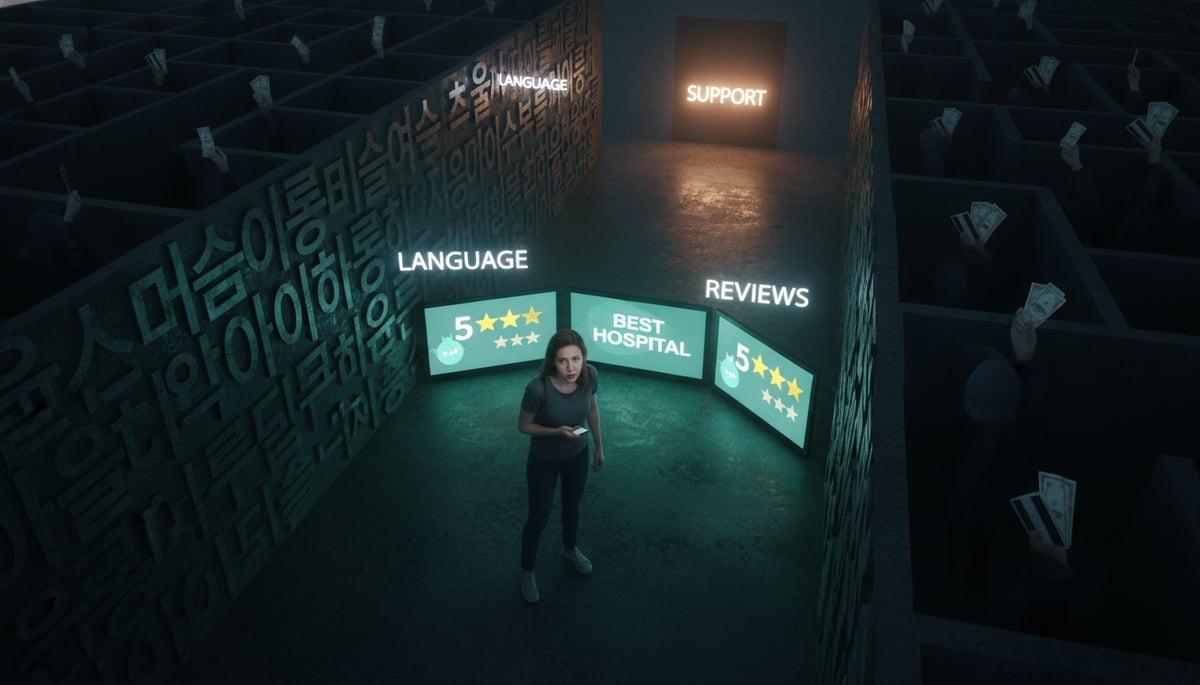
You arrive in Seoul, filled with anticipation. But immediately, you confront the language barrier—a formidable, concrete wall. Navigating a consultation, articulating your desires, expressing discomfort, or inquiring about critical risks becomes nearly impossible. You're left nodding, missing crucial nuances and vital information. This inability to fully communicate immediate concerns significantly compromises your safety.
Then, the predatory brokers emerge. The industry is saturated with illegal, unlicensed intermediaries lurking in obscure online forums, Facebook groups, and Telegram chats. These individuals charge exorbitant commissions, directing you to whichever clinic offers them the highest payout, not necessarily the best care for you. Often, this leads to subpar facilities. Official reports of these illicit operators have surged dramatically, from a mere 11 cases in 2021 to a startling 59 in 2023, indicating a worsening, chaotic environment. Even the Chinese embassy in Seoul felt compelled to issue a warning to its citizens – a stark indicator of the problem's severity. Al Jazeera’s investigation revealed anonymous facilitators openly admitting to operating without government licenses.
Compounding this, online reviews are frequently fabricated. Clinics routinely offer discounts, or even full refunds, in exchange for positive testimonials, or worse, the deletion of negative ones. For example, a patient named Alex was pressured to remove her critical review from the Gangnam Unni app, offered money back only upon signing a confidentiality agreement. The information you consume online is often a carefully constructed illusion, dangerously distorting reality.
To even navigate the city, essential apps like KakaoMap and KakaoTaxi are indispensable; Google Maps is largely ineffective in Korea. Savvy Reddit users consistently recommend these tools for practical assistance. Additionally, official support systems like the Gangnam Medical Tourism Centre exist and should be utilized as a crucial lifeline in this complex environment. Because the true threats are often not the surgeon’s scalpel, but the insidious whispers, fake smiles, and hidden agendas operating outside the sterile confines of the operating room. That is the undeniable truth.
Legal Recourse and Ethical Lines: What Happens When Things Go Wrong?

So, you’ve experienced a negative outcome. What now? Attempting to seek legal recourse for medical malpractice as a foreigner in South Korea is, frankly, a futile and costly endeavor. The legal system is simply not structured to protect you.
Adding to this complexity are South Korea's exceptionally strict defamation laws. Should you post about a negative experience online, even if factually accurate, you can still face severe penalties. This creates a chilling effect, silencing legitimate complaints and effectively shielding clinics from criticism. Al Jazeera's investigation into influencer contracts revealed clauses dictating positive language and strict confidentiality, illustrating how patients receive free surgery in exchange for signing away their right to speak freely.
Furthermore, the process encourages impulsive decisions. South Korea generally lacks mandatory waiting periods between consultation and procedure. Unlike France, which mandates a 15-day waiting period, or Australia, which recommends a 3-month cooling-off period, here, instant gratification prevails. This can lead to rushed, ill-considered decisions and subsequent profound regret.
While a doctor's 'duty to explain' risks is theoretically significant in Korean medical lawsuits, proving a violation—especially with a language barrier—is nearly insurmountable. Your signature on a consent form, however poorly understood, is often considered definitive. Academic legal studies, such as those found in PMC reviews, highlight the 'physician's obligation to provide sufficient explanations,' yet this ideal clashes with the realities of foreign patients' comprehension.
The landscape of influencer marketing further blurs ethical lines. Clinics routinely offer complimentary surgeries in exchange for 'positive content,' often under contracts that explicitly forbid disclosing the sponsorship. This creates a carefully orchestrated facade of authentic reviews, making it difficult for prospective patients to discern truth from advertising. Ultimately, when things go sideways, you’re usually on your own; the system is fundamentally designed to protect itself, not the foreign patient.
A 5-Step Checklist for a Safer Surgical Journey
Alright, so despite the warnings, you're still determined to proceed. I understand. But you must have a comprehensive battle plan. This isn't optional; you follow these steps rigorously, or you are simply rolling the dice with your health and appearance.
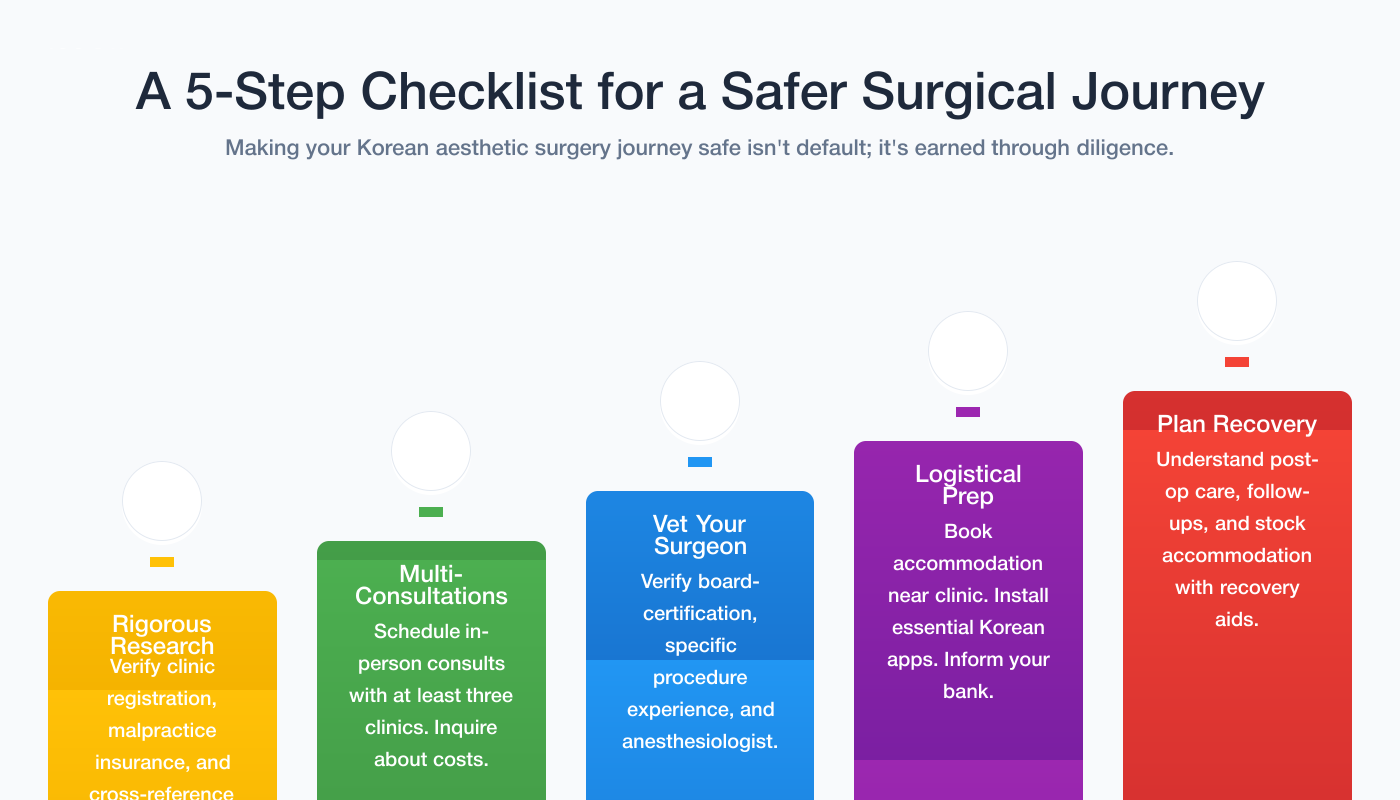
Step 1: Rigorous Research. This demands genuine effort, far beyond Instagram scrolls. Engage with official resources, such as the Gangnam Medical Tourism Centre, which should vet clinics. Verify that any hospital you consider is registered to treat foreign patients and carries appropriate malpractice insurance. A lawsuit is useless if the clinic isn't insured. Cross-reference every piece of information; never trust a single source. Consult two, ideally three, independent sources. This is your face, your body – thorough research is non-negotiable.
Step 2: Multiple Consultations. You wouldn't commit to the first person you meet, so why trust the first doctor? Schedule in-person consultations with at least three different clinics. While online consultations are useful for preliminary discussions, you need to be there physically to assess the environment and the overall vibe. Inquire about CT scans – some clinics offer them free, others charge. Understand all potential costs upfront, as small charges accumulate rapidly.
Step 3: Vet Your Surgeon. This is where most individuals make critical errors. Ask direct, pointed questions: Is the surgeon board-certified specifically in plastic surgery, not general surgery or another specialty? What is their verifiable experience with your exact procedure? Crucially, who will administer the anesthesia – a qualified anesthesiologist, or a technician? Be extremely cautious. If your primary contact is a consultant and not the actual surgeon, consider it a significant red flag.
Step 4: Logistical Preparation. This isn't complex, yet it's frequently overlooked. Book accommodation within comfortable walking distance of your clinic; navigating taxis with a swollen face will be challenging. Install essential Korean apps: KakaoTalk for clinic communication, KakaoMap for reliable navigation (Google Maps is largely ineffective here), and a robust translation app. Before departing, inform your bank of your travel plans and anticipated large transactions to avoid card denials—a potential nightmare.
Step 5: Plan Your Recovery. This phase is often minimized but is absolutely critical. Fully understand the post-operative care plan, down to every detail. Clarify follow-up appointments and whether treatments like LED or oxygen therapies are included or incur additional costs. Prepare your accommodation by stocking easy-to-eat foods and entertainment for your downtime. Consider deswelling aids, such as pumpkin juice, which many experienced patients on Reddit endorse. Your recovery is as vital as the surgery itself; meticulous planning is paramount.
Because without this comprehensive framework, you're not undertaking surgery; you're simply taking a reckless gamble, and this isn't Vegas – it's your body. Be smart.
Disregard the pretty pictures and the glossy marketing. 'Is Korean plastic surgery safe?' is, frankly, the wrong question. The real inquiry is: can you make it safe? Because safety isn't a default setting there; it is earned, every single time. (Remember, this is about your face.)
This is not a vacation package; it's navigating medical tourism in a 'Wild West' landscape. If you seek the unvarnished truth, here it is:
- Those jaw-dropping results are indeed achievable, but they originate from top-tier surgeons, not discount clinics. Identifying these elite professionals requires serious, painstaking vetting on your part—there are no shortcuts.
- Brokers will promise you the moon and more, but their loyalty lies with their commission, not your wellbeing. Relying on them for critical decisions is an invitation to significant trouble.
- The language barrier isn't merely a hurdle; it's a solid brick wall. If you cannot fully comprehend the procedure, its inherent risks, or the post-operative care instructions, you are gambling heavily with your health. Genuine informed consent demands complete comprehension.
Ultimately, you can achieve phenomenal results in Korea, or you can become a cautionary tale. The critical difference lies in your diligence – that is your only shot at a safe outcome.
So, enough reading. Take action. If you are serious about bypassing guesswork and connecting with verified surgeons who truly understand your language – and your face – seek direct channels. Stop leaving your future to chance.
Tags
Related Articles

How to Choose the Right Plastic Surgeon in Korea: A Guide for International Patients

Online Consult Savings: The Shocking Truth About Korean Plastic Surgery