
Korean vs. Western Plastic Surgery: A Comprehensive Comparison for 2025
Read about Korean vs. Western Plastic Surgery: A Comprehensive Comparison for 2025 on faceon
South Korea's plastic surgery market is projected to hit an astounding twelve billion dollars by 2034 – a clear indicator of its global influence. Fueled by the immense popularity of K-pop and its associated aesthetic, people worldwide are increasingly seeking that specific look. This surge inevitably leads to one crucial question: is Korean surgery actually better than what's available in the West? (The short answer: No.)
Forget the Instagram filters and clinic marketing hype. This isn't about before-and-after photos enhanced with better lighting than your wedding day. What we're truly examining are two fundamentally different approaches to aesthetic transformation, both for the face and the body.
This isn't a puff piece designed to sell you a flight to Gangnam. We're cutting through the noise, providing facts on aesthetic goals, the actual surgical techniques employed, the true financial commitment, and what the entire patient journey entails. (It's not always pretty, or simple.) Ultimately, your ideal choice isn't about finding what's 'better,' but about discovering what genuinely aligns with your personal aesthetic and journey.
Briefing & TL;DR: The Core Differences at a Glance
So, you're considering a new look. The critical decision? Korea or the West? This isn't a simple either/or scenario; it's a complex interplay of philosophical ideals, advanced techniques, varying patient care models, and the often-misunderstood real costs.
Here's the essential distinction: Korean clinics predominantly pursue a <mark class="hl">V-shaped</mark> face – a collective, harmonized ideal. This contrasts sharply with Western aesthetics, which generally focus on enhancing individual features or achieving a more youthful, "refreshed" appearance. Technologically, Korean surgeons are renowned masters of facial bone contouring, jawline refinement, and intricate rhinoplasty. However, procedures like breast augmentation and comprehensive body sculpting still largely remain a Western domain, a procedural difference even supported by data from platforms like Similarweb (2024).
Post-operative care is another significant differentiator. In Korea, patients often receive intensive, "babysitting" style care, a stark contrast to the typically more independent recovery model in the West. While Seoul's sticker prices might appear lower, these "savings" quickly evaporate when factoring in flights, accommodation, and potential revision trips. This decision is a nuanced equation, far beyond a simplistic "better" versus "worse" comparison.
Don't just chase a trend; understand the whole damn package before you pick a side.
The Philosophical Divide: Defining Beauty in Seoul vs. San Francisco
Think beauty is a universal language? Think again. It's profoundly cultural, especially when comparing aesthetic surgery in Seoul to, say, San Francisco. The underlying philosophy—what constitutes "beautiful"—shifts dramatically.

In South Korea, the goal is often conformity to a specific, almost celebrity-driven ideal, aiming to "look like everyone else, but better." This pursuit of a <mark class="hl">[collective ideal</mark>](https://en.wikipedia.org/wiki/South_Korean_beauty_standards) of harmony manifests in the V-line face, a delicate chin, and refined cheekbones (zygoma reduction). It's all about achieving a softer, slimmer, and often younger look. This trend starts early, with many young women in Seoul receiving surgery as a competitive advantage; reports, including those by The New Yorker, suggest that a significant proportion of women in the capital have undergone aesthetic procedures.
Conversely, the West generally still champions individuality, or at least the illusion of it. The focus is on enhancing existing features, aiming for a "rested" or "refreshed" appearance rather than a complete transformation. Here, a strong jawline might be a coveted trait, symbolizing strength—a stark cultural split highlighted by experts like Dr. Kim when comparing the V-shape to a powerful jawline.
Even "subtlety" holds different meanings. In the West, subtlety implies a natural enhancement, where no one suspects you've had work done—you, just a better version, as discussed on blogs like MarottaMD. In Korea, subtlety means achieving the ideal V-shape without it overtly screaming "surgery." The societal acceptance also differs: many US patients keep their procedures quiet due to lingering stigma, while in Korea, it can be almost a badge of honor. Your definition of 'beautiful' might just be a regional preference, and the surgeons are trained to deliver it.
A Tale of Two Scalpels: Comparing Core Surgical Techniques
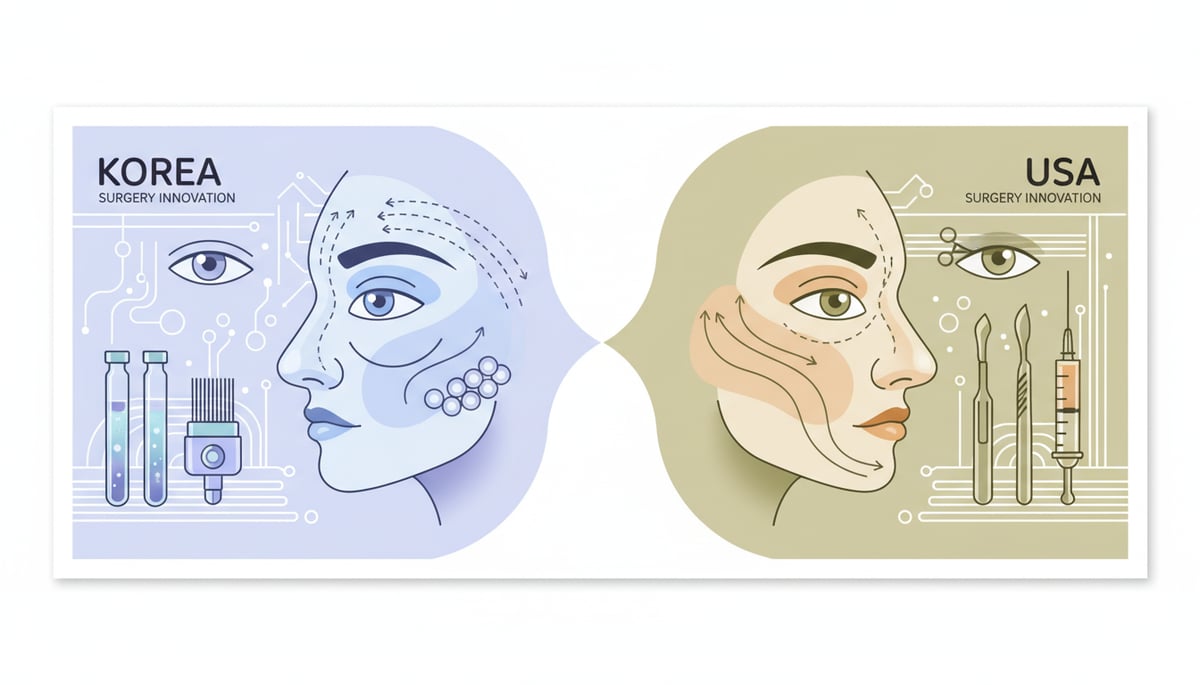
When it comes to the actual surgical execution, the tools and methodologies employed diverge significantly. It's not just about what you desire, but what surgeons are specialized in, and what they're willing to innovate.
Consider facelifts. The deep plane technique, known for its natural and long-lasting results, has been widely adopted by Korean surgeons. Yet, they often go further, incorporating surgical thread lifts as additional scaffolding for enhanced tightness—a practice less common in the US, where surgeons might rely solely on the deep plane. Dr. Kim's observations at APS meetings in Korea confirm this continuous drive to push boundaries.
Rhinoplasty, or nose jobs, exemplifies a distinct art form. In Korea, the focus is largely on augmentation, building up lower nasal bridges and refining tips with cartilage grafts (often from ear or rib) to create a delicate, almost doll-like nose—a specific aesthetic mastery well-documented by Jivaka's analysis of specialized Korean procedures. Western rhinoplasty, however, typically involves reduction: addressing humps, correcting septal deviations, and prioritizing both aesthetic refinement and structural integrity for optimal breathing.
Eyelid surgery, or blepharoplasty, also presents a fascinating contrast. The most common procedure in Korea is "double eyelid surgery," which creates a distinct crease above the eye, a highly sought-after feature. In the West, blepharoplasty is more commonly associated with older patients, addressing sagging lids and under-eye bags to restore a more youthful or alert appearance—highlighting a different demographic focus, as seen in "Top 5" procedure data.
Beyond established procedures, Korea acts as an aesthetic testbed, a hub of innovation. They aggressively adopt new technologies, like the <mark class="hl">[Agnes Medical Double-Tite</mark>](https://bimedis.com/a-item/face-lift-machines-agnes-medical-double-tite-2580889)—a combination of RF microneedling and direct skin booster delivery. Skin boosters themselves, like Rejuran (salmon DNA) and Juvelook (PLLA), are extensively used and refined. Many of these cutting-edge treatments are not yet FDA-approved in the States, making Korea a fast-moving, less regulated, "wild west" of aesthetics. This environment fosters rapid experimentation and perfection, often giving them a significant lead in emerging techniques.
Don't mistake different for inferior; Korea's market pushes boundaries, for better or worse.
The Price Tag: A Realistic Cost-Benefit Analysis Beyond the Quote
You've seen the numbers – perhaps a gleaming website touting a Korean facelift for ₩8M to ₩15M, a fraction of the ₩20M to ₩35M you'd expect in the US. This initial sticker price is indeed tempting, but it's merely the very shallow tip of a much larger financial iceberg.
Have you factored in the transatlantic flights – an 18-plus hour journey that's anything but relaxing? Then there's accommodation for two to three weeks, daily expenses for food, and local transportation. These seemingly minor costs rapidly accumulate, often shrinking, or entirely eliminating, the purported "40% to 80% savings" on the procedure itself. You must live there, and living, it turns out, is not free.
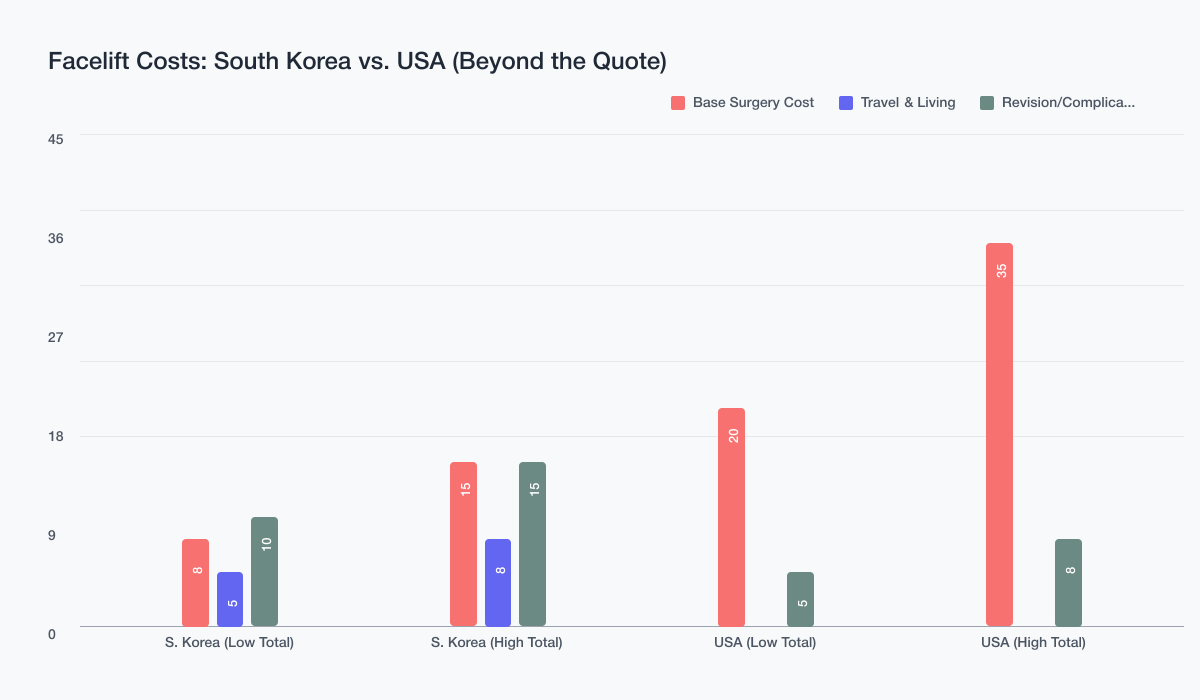
Then there are the hidden costs—expenses that aren't accidental omissions but rather remain unmentioned until they become unavoidable. What if complications arise? And they do happen. A revision surgery means another exorbitant flight, another two weeks of living expenses, just to return to the original surgeon. Or, you're left seeking a Western doctor willing to correct another's work, which is often difficult to find and prohibitively expensive, potentially exceeding your initial "savings." Suddenly, that "cheap" surgery becomes a perilous and costly endeavor.
To Korea's credit, many reputable clinics offer bundled post-operative care: daily check-ups, de-swelling treatments, IV drips, and oxygen chambers for several days. This intensive, included aftercare is a significant advantage, as comparable daily support in the US would incur substantial additional costs. In this specific aspect, you might indeed get more value for your money.
However, as a foreign patient, you are often subject to "tourist pricing." Online forums like Reddit are replete with warnings about foreigners receiving inflated quotes compared to locals, or "all-inclusive" packages that mask mediocre service. You might believe you're securing a deal, but in reality, you could be paying a premium for an average or even subpar experience. Resources like a dedicated medical tourism platform, Jivaka's breakdown or Gangnam Medical Concierge aim to demystify these costs, but individual clinics often play their own pricing game.
Focusing on the initial surgical quote is a rookie mistake; a true financial analysis, factoring in travel, living, and risk, means those supposed savings often shrink or just vanish.
The Patient Journey: Factory Clinics, Intensive Aftercare, and Language Barriers
So, you've landed in Korea and made your way to a clinic. But which kind? This critical distinction is often overlooked. Korea's system is dichotomous: you have high-volume factory clinics like Toxnfill or Ppeum, known for their speed, affordability, and assembly-line efficiency—an experience that can feel impersonal and intimidating. Then there are the private clinics, promising personalized, specialized care, at a higher price point. This initial choice significantly impacts your entire journey.
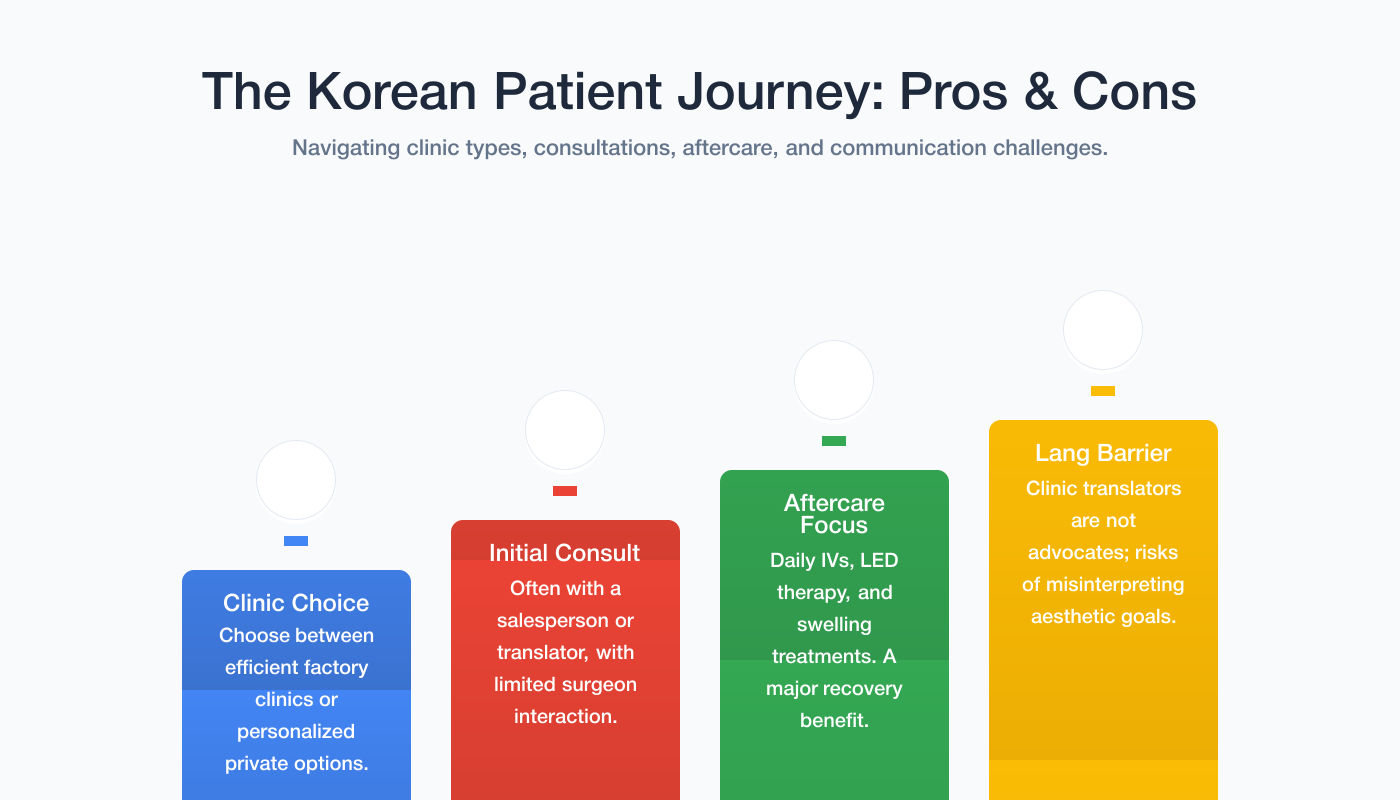
The consultation process itself differs greatly from Western norms. While you almost always meet your surgeon directly in the West, in some Korean clinics, particularly for international patients, your initial discussion might be with a salesperson or a translator. The actual surgeon might only grant you a fleeting five minutes, leaving you to convey deeply personal aesthetic goals to someone not wielding the scalpel—a precarious start to any significant procedure.
However, where Korean clinics undeniably excel is in aftercare. The post-operative support is intensive, often involving daily clinic visits for three to five days, featuring IV drips, LED therapy, and dedicated swelling treatments. This obsessive approach to recovery is deeply cultural, aimed at rapid healing and optimal results. In stark contrast, Western practices typically send you home with medication and an ice pack, leaving much of the recovery management to the patient. This intensive, hands-on recovery is a significant benefit, as evidenced by reports from experts like Dr. Kim.
The most dangerous hurdle, however, is communication. The language barrier isn't a minor inconvenience; it's a profound chasm. Your clinic's translator is an employee of the clinic, not an independent advocate for your best interests. When trying to articulate nuanced, subjective aesthetic desires, misunderstandings are rife. These misinterpretations can lead to unwanted results, a frustration and panic echoed in testimonials from platforms like AristocratPS, highlighting the crucial need for clear, unbiased communication.
The Korean patient experience prioritizes efficiency and intensive, hands-on recovery support, which is a huge benefit, but it often sacrifices that personalized, surgeon-led relationship you'd expect from a Western private practice.
Frequently Asked Questions (FAQs)
Content for Frequently Asked Questions (FAQs)
Alright, enough with the navel-gazing. You’ve waded through the hype, the data, the glossy photos. And if you’re still asking "which is better," you missed the point entirely. There’s no platinum trophy for one region. It’s not a competition between surgeons, but a clash of philosophies (and price points).
So, let’s cut to the chase. Here's what you actually need to remember:
- Korean beauty isn't just about a procedure; it's a look. They aim for a certain harmonious ideal, often a subtle but distinct transformation, a refined version of an East Asian aesthetic. Western surgeons? They're often preserving ethnic features, focusing on anti-aging, or delivering more dramatic size changes (think breasts) – a different starting line and finish line.
- Techniques are specialized, naturally. Korea has perfected intricate facial contouring, specific eyelid surgeries, and nose jobs that create a sharper, often taller bridge. Western practices are often global leaders in advanced reconstructive work, complex facial feminization, or broader body sculpting. Both sharp, but with different tools for different jobs.
- The whole patient journey feels different, too. Korea can be a high-volume, almost factory-like system – efficient, with aftercare often bundled. But it can feel impersonal. Western clinics offer more bespoke, one-on-one experiences (which, surprise, you pay handsomely for) and aftercare might be more fragmented.
Bottom line? Don't ask which is superior. Ask which philosophy, which approach, and what level of aftercare fits your damn face and budget. Because that's all that matters.
Your move: Stop agonizing over online forums. Get clear on your own goals, what kind of outcome you actually want, and your risk tolerance. Then, you need to talk to some real experts, not just lurk on Reddit. Find a doctor (or a platform like Face On Korea that helps you find them) who understands your vision and isn't just selling you a trend. Don't waste your money on guesswork.
Tags
Related Articles

Why Korean Clinics Are Setting the Gold Standard in Skin Rejuvenation

Online Consult Savings: The Shocking Truth About Korean Plastic Surgery